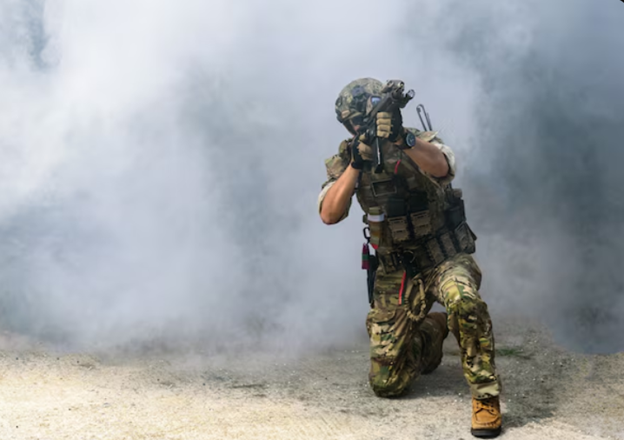
Everything else is gone — the gear, the plan, half the squad scattered in the dark. But one soldier still moves with total clarity, because he answered a question weeks ago that everyone else is only asking now: why am I actually doing this? Chaos didn’t touch that answer. It never could.
The One Thing Chaos Can’t Confiscate
Some people walk into disaster and completely fall apart. Others walk into the exact same disaster and somehow still know who they are. The difference rarely comes down to skill, training, or luck. It comes down to whether they’d already settled the “why” before the chaos ever started. This is the core of purpose under pressure: it isn’t something you discover in the middle of a crisis. It’s something you bring into the crisis, fully formed, and the crisis simply reveals whether it was real.
Motivation needs good conditions to survive — sunshine, encouragement, a clear path forward. Purpose doesn’t ask for any of that. It survives storms precisely because it was never dependent on smooth weather in the first place. That’s what makes it different from resilience or adaptability. Those are tools you use. Purpose is the reason you bother picking the tools up at all. This post digs into why that distinction matters so much once things actually fall apart.
What Purpose Looks Like When Everything Else Collapses
Purpose rarely gets tested when life is calm. It gets tested the moment everything familiar disappears — and it tends to show up in three specific ways.
When your role disappears
Lose a job title, a team, a rank, or a relationship that defined you, and you’ll feel it immediately: a strange, disorienting blankness. Most people build identity around what they do, so when the role vanishes, it can feel like the self vanished with it. This is the moment purpose under pressure either shows up or doesn’t.
When purpose gets reassigned, not erased
Here’s the encouraging part — purpose rarely dies in a crisis. It redirects. A soldier who loses his unit doesn’t lose his drive to protect people; he just finds a new way to aim it. A person who loses a career doesn’t lose their need to build something meaningful; they redirect that energy somewhere else entirely. The purpose stays intact. Only the target changes.
When purpose becomes the tiebreaker
In moments with zero good options, something has to make the final call, and it’s rarely logic — there usually isn’t time for that. It’s almost always purpose. What actually matters to me becomes the deciding vote when every other input goes quiet.
The Psychology of Purpose Under Pressure
This isn’t just a feel-good idea — researchers who study stress and coping consistently find real mechanisms behind it.
– A “why” contains pain instead of letting it spread. People with a clear sense of purpose tend to experience stress as something localized and manageable, rather than something that floods every part of their life at once.
– Purpose is identity-based, so it survives circumstance changes. Motivation depends on external conditions being right. Purpose depends on nothing except who you already believe yourself to be — which is exactly why it holds up when everything external falls apart.
– Shared purpose builds cohesion faster than shared tasks. Groups bonded only by a job get shaky the moment the job gets hard. Groups bonded by a shared “why” tend to hold together precisely when it matters most.
Purpose under pressure isn’t abstract inspiration. It’s a measurable psychological anchor, and it explains why some people keep their footing in chaos while others lose theirs entirely.
How to Build Purpose Before You Need It
You don’t want to discover you’re missing this in the middle of your worst week. Build it now, while the stakes are still low.
– Get specific about your “why” before a crisis forces the question on you
– Separate your identity from your role — ask who you are without the job title, the relationship, or the routine
– Notice what you protect instinctively when things get hard; that’s usually your real purpose talking
– Practice making values-based decisions in small moments, so the muscle is ready for big ones
Each of these strengthens the same thing: purpose under pressure, ready before pressure arrives.
The Real Test Isn’t the Crisis — It’s What’s Underneath It
Most people never face war-level stakes, but almost everyone eventually loses something that used to define them — a job, a relationship, a version of themselves they’d built an identity around. The real question isn’t whether that loss hurts. It will. The question is whether there was a purpose underneath the role, or whether the role quietly became the purpose. People who’ve done that internal work ahead of time don’t just survive the loss. They come out the other side still recognizably themselves.
One Soldier, One War, One Answer That Never Wavered
There’s a difference between believing this idea and watching someone actually live it. In 1968, a 19-year-old musician named J Curtis Marlatt got drafted straight out of the life he’d built — swimming scholarship, rising band, front-row seat to a cultural movement — and landed in the jungles of Vietnam with almost nothing familiar left standing. What stayed with him wasn’t luck. It was a stubborn, specific sense of who he was and what he was there to do, note by note, gig by gig, even under mortar fire. His story is what purpose under pressure actually looks like when the stakes are as real as they get.
Curious how far one clear sense of purpose can carry someone? Pick up Cap’n Zig Zag’s Blues Band by J Curtis Marlatt — a true story of music, war, and staying yourself when nothing else holds.